What to Check When Buying a Second Hand Trailer

A used trailer can save you real money - or hand you someone else’s problem with fresh paint on it. If you’re figuring out what to check when buying a second hand trailer, the goal is simple: make sure the frame is sound, the running gear is legal and safe, and the deal still makes sense after the repairs you’ll need.
That means looking past cosmetic stuff and paying attention to the parts that actually carry weight, track straight, and stop safely. A clean deck and shiny wheels do not tell you much. The frame, axle setup, coupler, wiring, tires, bearings, brakes, and paperwork tell you almost everything.
What to check when buying a second hand trailer first
Start with the trailer’s identity and basic fit for your job. Before you crawl underneath it, confirm the VIN plate or manufacturer tag is present and readable. If the seller can’t produce a title where your state requires one, or the VIN looks altered, walk away unless you know exactly how your state handles bonded or untitled trailers. Paperwork problems can turn a cheap trailer into a parked yard ornament.
Then check the ratings. Look for the GVWR, axle rating, tire load range, and trailer size. A lot of buyers focus on bed length and forget payload. A 16-foot trailer with light axles may still be the wrong trailer for a compact tractor, side-by-side, or palletized material. Make sure the trailer’s actual design matches what you plan to haul, not just what the seller says it can handle.
Inspect the frame like it matters, because it does
The frame is the expensive part. Tires, lights, and even axles can be replaced. A bent, cracked, or badly rusted frame usually kills the deal.
Look closely at the main rails, crossmembers, tongue, spring hangers, and rear section. Surface rust is common and not always a problem. Deep scaling, flaking, swelling around welds, or rust holes are different. Probe suspect areas with a screwdriver or pick. If the steel sounds thin or starts shedding layers, you’re not looking at harmless cosmetic rust.
Pay extra attention to welded repairs. Some repairs are fine if they were done properly. Others are cover-ups for overloading, collisions, or poor design. Sloppy weld beads, mismatched steel, fish plates slapped over cracks, and fresh paint in one suspicious area should make you slow down and ask better questions.
Stand back and sight down both sides of the trailer. Does it sit level? Do the wheels look centered in the fenders? Does the tongue line up straight with the frame? A trailer that dog-tracks, leans, or shows uneven geometry may have axle or frame damage.
Rust is about location, not just amount
A used trailer in the Rust Belt or near saltwater can still be worth buying, but rust around spring mounts, axle seats, coupler attachment points, and the tongue deserves more scrutiny than rust on a removable fender. Structural rust in high-stress areas is what matters.
Axles, suspension, and hubs tell you how the trailer was treated
A lot of second-hand trailers are sold right when the running gear starts asking for money. That doesn’t always mean they’re bad buys, but it does mean you need to inspect them with your eyes open.
Check leaf springs for broken leaves, flattening, shifted packs, and worn bushings. Look at equalizers on tandem-axle trailers for elongation or sloppy movement. On torsion axles, watch for arms sitting at odd angles or one side sagging lower than the other. Suspension wear often shows up as uneven tire wear before anything else.
Spin each wheel if you can. Listen for grinding, roughness, or play in the bearings. Grab the tire top and bottom and rock it. A little movement can mean adjustment is needed. Noticeable clunking can mean bearing wear, loose hardware, or worse. Pulling a hub for inspection is ideal if the seller allows it, especially on an older trailer with unknown service history.
Check for axle overload clues
Bent axles, tires worn heavily on the inside or outside, and a trailer that looks bowed under no load all suggest overload history. That matters because overloading damages more than the axle. It can fatigue the frame, spring hangers, coupler area, and welds over time.
Tires can expose neglect fast
Trailer tires age out before they wear out on a lot of used rigs. Don’t get distracted by tread depth alone. Read the DOT date code and check the sidewalls for cracking, bulges, weathering, or separation. If the tires are more than a few years old, budget for replacement even if they still look usable.
Make sure all tires match in size and load range. Mismatched tires on a tandem trailer can cause uneven loading and bad tracking. Passenger-car tires on a trailer that should be running ST-rated trailer tires are another sign the previous owner cut corners.
Also inspect the wheels themselves. Elongated lug holes, cracks around the center, and heavy rust at the bead seat are all red flags.
Coupler, jack, chains, and breakaway gear deserve a hard look
The coupler is not an accessory. It is the point that keeps the trailer connected to your tow vehicle.
Make sure the coupler latch operates cleanly and fits the ball size marked on it. Excess slop, cracked castings, bent latch parts, and ugly weld repairs are reasons to pass. Safety chains should be properly attached, not hooked through random hardware or light-gauge tabs. The jack should crank smoothly and not be bent, loose, or torn at the mount.
If the trailer has electric brakes, inspect the breakaway switch and battery. A missing battery box, corroded wiring, or a switch cable tied in a knot tells you maintenance probably wasn’t a priority.
Brakes and lights are where cheap deals get expensive
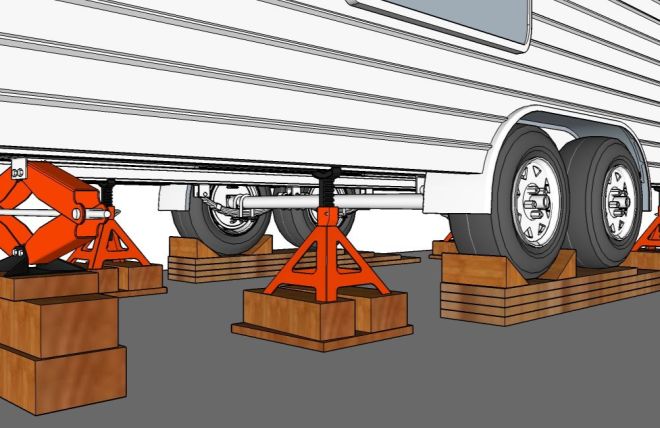
If the trailer is large enough to require brakes, verify they actually work. Don’t accept “probably just a fuse” as a diagnosis. Plug the trailer into a tow vehicle with a working brake controller and test the brake response. If possible, jack up the wheels and confirm brake activation manually.
With electric brakes, look for cut wires, bad splices, damaged backing plates, and grease contamination from failed seals. With surge brakes, inspect the actuator, fluid condition, lines, calipers or wheel cylinders, and signs of leakage. Hydraulic brake repairs can add up fast if the system has been neglected.
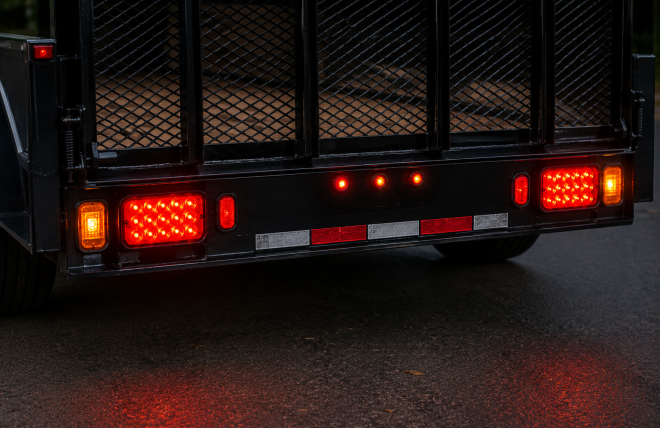
Test every light. Running lights, brake lights, turn signals, and side markers should all work. Bad trailer wiring is common and fixable, but a harness full of household wire nuts, twisted splices, or exposed copper usually means you’ll be redoing the whole thing.
Deck, ramps, and hardware matter more than they look
A wood deck with some wear is normal. Rot around fasteners, soft spots, split boards, and loose attachment points are not. Re-decking may be acceptable if the trailer price reflects it, but it still adds labor and material cost.
Steel decks should be checked for rust-through, bent sections, and poor repairs. On equipment trailers, inspect ramps, ramp supports, hinge points, and spring assist hardware. If the ramps are bent or the support structure is cracked, the trailer may have seen hard use with machines heavier than it should have carried.
Tie-down points should be solid and properly attached. Stake pockets, D-rings, and rub rails often reveal how seriously the trailer was built in the first place.
Ask questions that reveal maintenance history
The seller’s answers matter, but how they answer matters too. Ask what they hauled, how often they used it, whether the bearings were serviced, whether the brakes were maintained, and what has been replaced recently. A seller who knows the axle brand, tire age, bearing service interval, and brake work history is easier to trust than one who only says, “It pulls fine.”
That said, new paint, new lights, and new boards right before a sale can go either way. Sometimes it means the owner cared for it. Sometimes it means they’re trying to distract you from frame issues. Look underneath before you get impressed on top.
Price the trailer with repairs included
A used trailer is only a deal if the total cost stays reasonable after catching up on maintenance. Tires, bearings, brakes, decking, wiring, and coupler parts can stack up quickly. If you’re looking at a cheap trailer that needs all of those, compare that total against a better used unit or even a basic new one.
This is where a no-nonsense inspection saves money. A trailer with ugly paint and good bones is often a better buy than one that looks sharp and hides structural problems. Trailer Sauce readers usually understand this already - steel condition and running gear matter more than cosmetics.
Bring a flashlight, a jack if the seller allows it, a tire gauge, and enough skepticism to ignore sales talk. If the trailer passes inspection, great. If it doesn’t, the best repair bill is the one you never volunteer to own.
A good second-hand trailer should leave you thinking about the jobs you can do with it, not the parts you have to order before it’s safe to tow.